By Dr.s Jill Glasspool Malone and Robert W. Malone Audio Version:
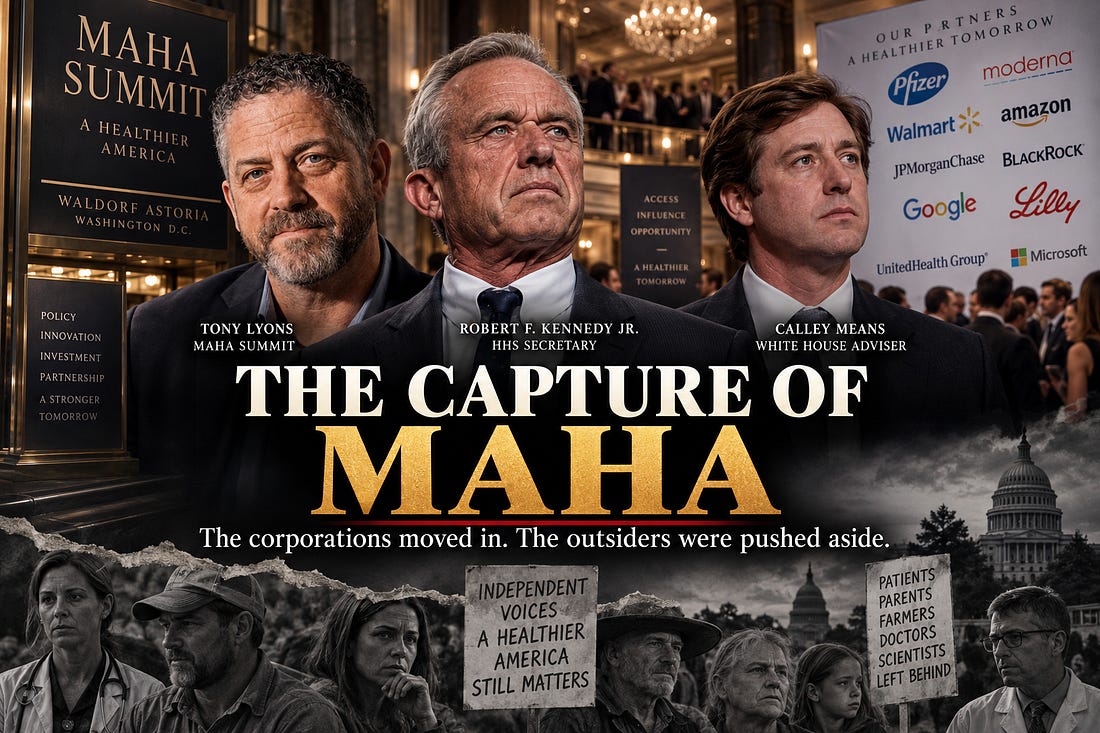
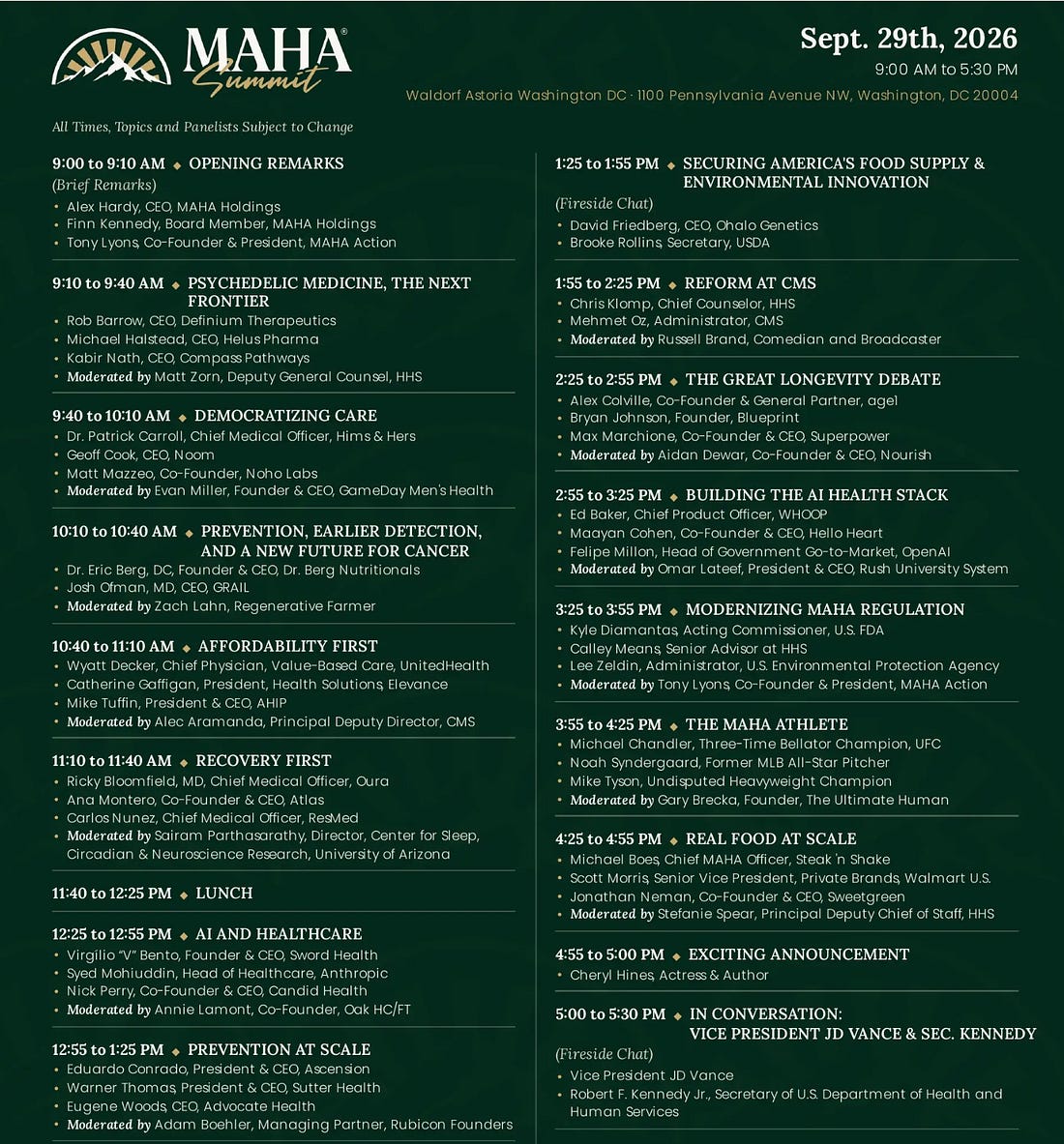
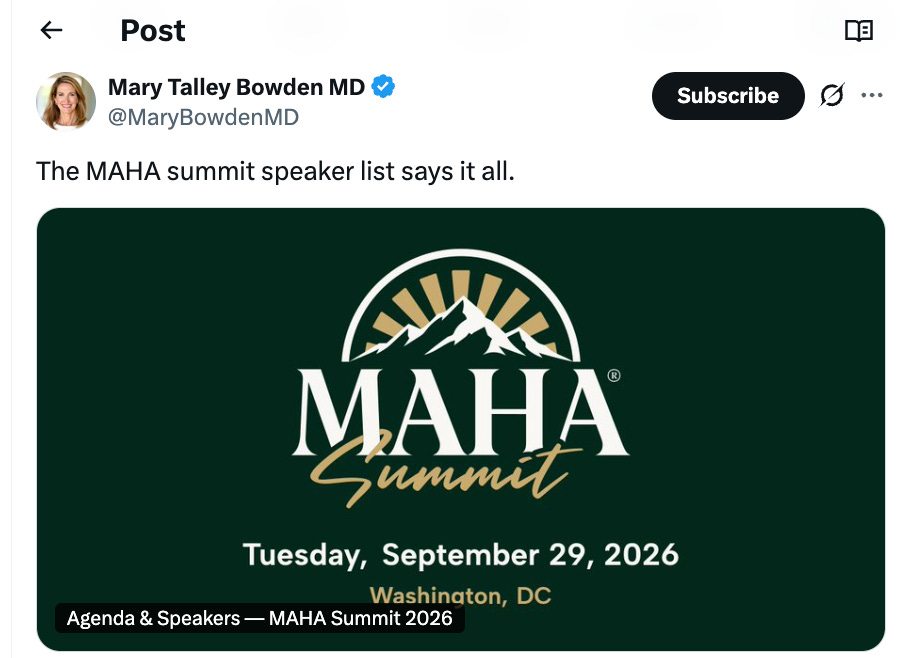
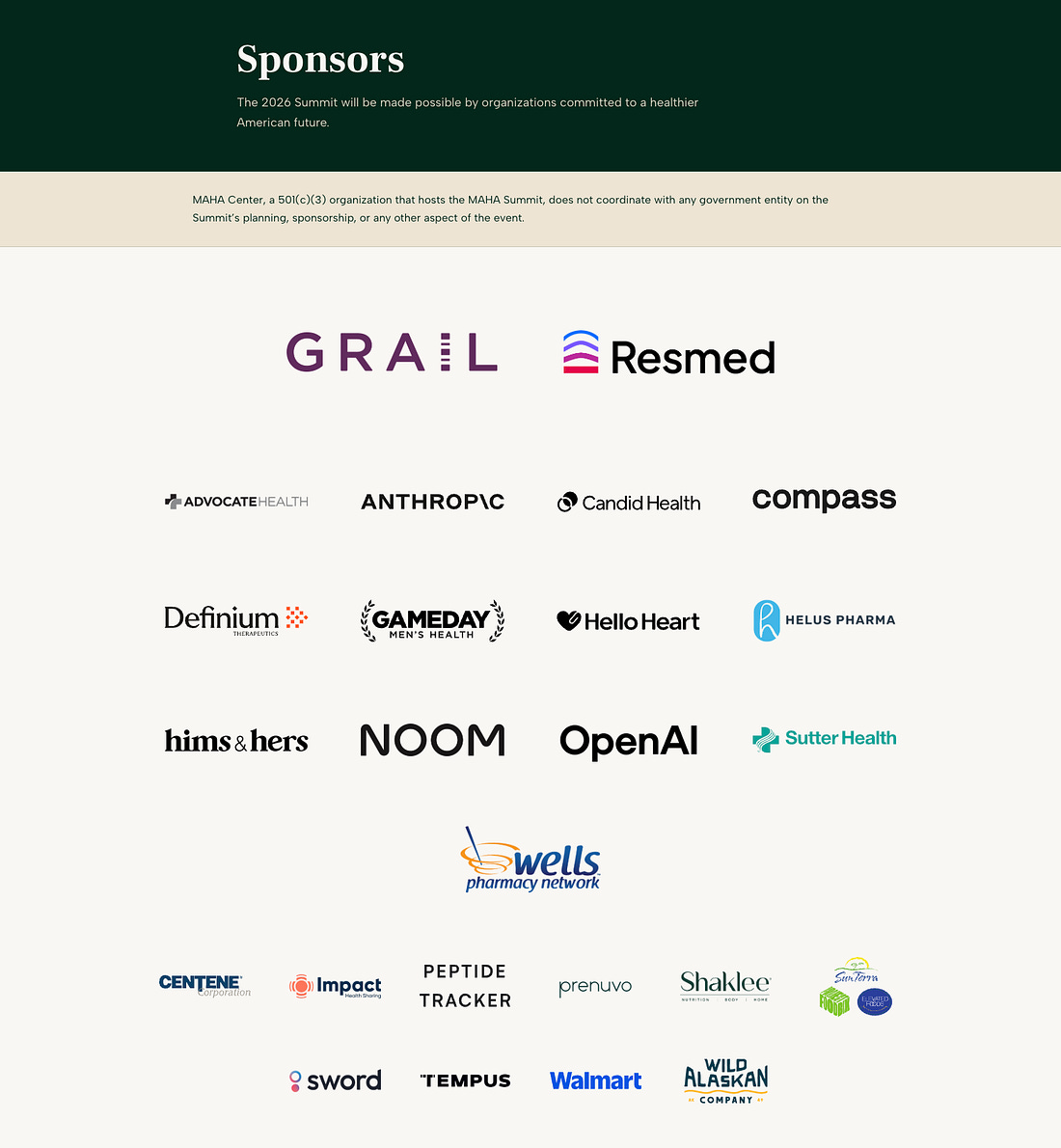
Tomorrow, September 29, the second annual MAHA Summit will be held at the Waldorf Astoria in Washington, D.C. Today, I looked at the speakers and was genuinely taken aback. Then the picture became considerably clearer when I took a gander at the sponsor list. This is being advertised as “a one-day gathering of the foremost leaders shaping the future of American health,” culminating with Vice President JD Vance and HHS Secretary Robert F. Kennedy Jr. But much of the day is not devoted to the physicians, scientists, farmers, parents, patients, medical-freedom advocates and independent researchers who spent years building the constituency that ultimately became MAHA. In fact, not a single one of them has been asked to speak. Instead, the program is heavily populated by executives from some of the largest health-care corporations in America, major hospital systems, health insurers, technology companies, venture-backed medical businesses and companies whose fortunes may depend upon decisions being made by the very federal agencies represented at the conference. The official agenda includes UnitedHealth, Elevance Health, AHIP, Walmart, GRAIL, ResMed, Compass Pathways, Definium Therapeutics, Hims & Hers, Noom, Advocate Health, Sutter Health, Anthropic and OpenAI, among many others. Senior officials from HHS, CMS, FDA, NIH, USDA and EPA are appearing alongside them. MAHA Summit 2026.
To understand why this is so jarring, remember what MAHA was supposed to represent. What Bobby Kennedy promised us. It did not arise because Americans believed that the health insurance industry needed a larger voice in Washington, that hospital conglomerates lacked influence, that Silicon Valley needed better access to government, or that venture capital was insufficiently represented in health policy. Quite the opposite. The movement grew because millions of Americans concluded that the institutions controlling medicine, food, agriculture and public health had become far too intertwined with the industries they were supposed to oversee. They watched regulatory agencies defer to pharmaceutical companies, doctors lose autonomy to enormous health systems and insurers, small farmers struggle under rules written for industrial agriculture, and dissenting scientists marginalized by institutions increasingly dependent upon government and corporate money. Whatever else one thinks of MAHA, its political energy came from that profound loss of trust. That is why the Summit program is worth examining closely. It raises a simple question that should not be dismissed merely because the people currently occupying HHS are people many in the movement supported: Who exactly is MAHA for now?
Perhaps nothing captures the problem better than the 10:40 a.m. panel titled “Affordability First.” The people chosen to discuss affordability are Wyatt Decker, chief physician for value-based care at UnitedHealth; Catherine Gaffigan, president of Health Solutions at Elevance Health; and Mike Tuffin, president and CEO of AHIP, the national trade association for health insurers. The moderator is a senior CMS official. MAHA Summit 2026 There is nothing inherently wrong with hearing from insurance executives at a conference on institutionalized health care. They understand their industry and should be required to defend its practices publicly. Perhaps the most tone-deaf choice on the entire program is the inclusion of UnitedHealth on a panel called “Affordability First.” Less than two years ago, on December 4, 2024, UnitedHealthcare CEO Brian Thompson was shot and killed outside a Manhattan hotel as he arrived for the company's investor conference. Luigi Mangione is on trial for that murder and has pleaded not guilty to charges arising from the killing. But something happened in the days after Thompson's death that should have terrified the health-insurance industry, and should certainly have been understood by anyone claiming to lead a populist health-reform movement.
A remarkable number of Americans did not respond primarily by defending UnitedHealthcare. They began telling their own stories about denied claims, prior authorizations, treatments delayed while patients became sicker, hours spent fighting insurance companies, and medical decisions made not between doctor and patient but by corporations deciding whether they would pay. Reuters described the killing as igniting an “outpouring of anger” from Americans struggling to obtain and pay for medical care. The reaction became so widespread that it developed into a national discussion about something much larger than the crime itself. The incestuous nature of MAHA is becoming harder to ignore, and the conflicts of interest seem to multiply by the day. GRAIL is a marquee sponsor of the MAHA Summit while its flagship Galleri cancer test is before the FDA. Its CEO gets a seat on the Summit stage. Casey Means invested in Function Health, which now offers GRAIL’s Galleri test to its members. Meanwhile, the same small circle of people moves among MAHA Center, MAHA Action, MAHA PAC and MAHA Institute, while corporations with business before the federal health establishment sponsor the gathering alongside senior government officials. Any one of these relationships might be dismissed as incidental. Taken together, they demand transparency. MAHA was supposed to expose the revolving door between money, industry and government, not build its own. GRAIL is a marquee sponsor of the MAHA Summit while its flagship Galleri cancer test is moving through the FDA approval process, and its CEO has been given a seat on the Summit stage. That is a conflict of interest that demands disclosure. How much did GRAIL pay? Which sponsorship package did it purchase? What did that money buy? Was the speaking slot part of the package? Did GRAIL have input into the panel topic, its composition, or the other speakers? Which HHS or FDA officials attended meetings, dinners, or private events involving GRAIL? MAHA built its credibility by exposing the entanglement of corporate money, regulatory access, and government power. It does not get a pass when those same relationships occur under the MAHA banner. The psychedelic medicine session presents a similar problem. It is titled “Psychedelic Medicine, the Next Frontier” and features the chief executives of Compass Pathways, Definium Therapeutics and Helus Pharma. Compass and Definium also appear on the Summit sponsor graphic supplied by the organizers. Moderating the session is Matt Zorn, Deputy General Counsel of the United States Department of Health and Human Services. MAHA Summit 2026 Again, psychedelic medicine is a perfectly legitimate subject for scientific discussion, and promising therapies should not be rejected merely because commercial companies develop them. But this is an extraordinarily peculiar format for a movement that made conflicts between regulated industries and federal health officials one of its central grievances. The question is not whether company executives should be allowed in the ballroom. The question is why this conference organized around them. And then Bloomberg reported what may be the most damning part of this entire affair. On September 19, Bloomberg Law revealed that prospective Summit sponsors were being offered packages reaching $300,000. At that level, this was not simply sponsorship. According to Bloomberg, the package included a guaranteed speaking slot, “meaningful input on the panel composition and topic,” and a private dinner for 30 guests with HHS Secretary Robert F. Kennedy Jr. and CMS Administrator Mehmet Oz. Bloomberg Law investigation Call this what it is. Corporate interests were being offered the opportunity to buy access, buy a microphone, and buy influence over who shared the stage and what that stage would discuss. This was not a $25,000 logo on a conference banner or underwriting lunch and audiovisual equipment. For $300,000, a corporation could reportedly help shape the conversation itself while gaining extraordinary proximity to two of the most powerful health officials in the federal government. MAHA rose to prominence by condemning precisely this convergence of money, access, industry influence, and government power. Now MAHA has morphed into what it was created to eliminate. HHS has stated that its officials “were not involved in the planning or sponsorship activities” and were unaware of the arrangements described by Bloomberg. But that hardly answers what has happened here. This is not merely a transparency problem. It is a betrayal of what MAHA claimed to stand for. A movement built on exposing the corrupting relationship between corporate money, privileged access and government power is now holding a Summit where, according to Bloomberg, corporations were offered speaking slots, influence over panel composition and subject matter, and a private dinner involving the Secretary of HHS and the Administrator of CMS for packages reaching $300,000. The defense that Kennedy, Oz and other HHS officials did not know what was being sold in their names does not make this better. It raises the question of how an organization operating under the MAHA banner was permitted to commercialize access to them in the first place. The people who built this movement were promised an end to this kind of Washington influence-peddling, not a MAHA-branded version of it. What bothers me most is not any single corporation on this list. It is who is missing. I know many of the people who spent years doing the difficult, often personally costly work that created the constituency now called MAHA. Physicians who lost positions and privileges because they refused to remain silent. Scientists who watched open scientific debate give way to institutional orthodoxy. Vaccine-injured patients and their families. Independent doctors fighting to practice medicine without becoming functionaries of enormous hospital systems and insurance companies. Farmers and ranchers struggling under a regulatory structure increasingly built around industrial agriculture. Small food producers and meat processors fighting rules that protect enormous incumbents. Researchers who documented financial conflicts throughout medicine and public health long before doing so became politically fashionable. Parents who organized, testified, protested and endured years of ridicule because they insisted that responsibility for their children belonged first to families, not bureaucracies. These people were not an interest group within MAHA. They were MAHA. Yet at the movement’s premier Washington gathering, they are remarkably difficult to find. And no, filling the program with Trump administration officials does not solve that problem. Government officials are not independent MAHA voices. They are now the government. Look instead at the architecture of the day. Health insurers explain affordability. Giant hospital systems discuss prevention. Psychedelic drug companies tell the audience about the future of psychedelic medicine. Silicon Valley companies discuss building the AI health stack. Walmart explains real food at scale. GRAIL, with its flagship cancer test moving through the FDA approval process, receives marquee sponsor placement while its CEO takes the stage to discuss cancer detection. Federal officials are woven throughout the program. Meanwhile, the dissident physicians, vaccine-injury advocates, independent scientists, medical-freedom activists, small farmers, patients and parents who actually built this movement are scattered so thinly through the agenda that their absence becomes impossible to miss. The outsiders who created MAHA have largely been displaced on its biggest stage by government, corporations and industries with enormous financial interests in the policies that government controls. That is not MAHA gaining a seat at the establishment’s table. This is the establishment taking over MAHA’s table. There is an enormous difference between bringing industry into the room and allowing industry to purchase the room. A genuine reform summit would put UnitedHealth onstage across from an independent physician who spends every day battling UnitedHealth. It would put GRAIL’s CEO beside an epidemiologist or screening expert with no financial relationship to the company. It would allow psychedelic developers to make their case while independent researchers interrogate their evidence. It would invite Anthropic and OpenAI while giving critics of centralized artificial intelligence an equal opportunity to question where this technology is taking medicine. That would be a debate. What appears on this program too often resembles a corporate sales presentation. The truth is that institutional incentives matter. Financial relationships matter. Access matters. Who funds an organization matters. Who gets invited into the room matters. Who does not get invited matters. None of those principles suddenly expires because Robert F. Kennedy Jr. is Secretary of HHS rather than Xavier Becerra. A conflict that deserved scrutiny under the Biden administration deserves scrutiny under the Trump administration. Corporate proximity to regulators cannot become acceptable merely because the regulators are now people associated with a movement one supports. Perhaps this is what happens when an insurgency finally reaches Washington. In the beginning there is no money, no access and certainly no power. Meetings happen in borrowed rooms. Scientists are dismissed as cranks, physicians as troublemakers, parents as extremists and farmers as irrelevant. Then the insurgency succeeds, and almost overnight the people who wanted nothing to do with it discover they were sympathetic all along. The lobbyists arrive. The consultants arrive. Corporate money arrives. CEOs who were nowhere to be found during the fight suddenly want seats on panels, introductions to officials and a place inside the movement. Invitations acquire value. Access becomes currency. And eventually the establishment figures out that it does not have to defeat the rebellion. It can buy its way into it. That is how capture works. It happens through money, access, relationships, and the gradual replacement of the people who built the movement with people who can afford to purchase proximity to it. One day the outsiders finally reach the table and discover something extraordinary: the people they spent years fighting have been kicked out of the room. That is why tomorrow’s MAHA Summit matters. The people running MAHA finally acquired something they lacked a few years ago: power. And with power came the money, corporations, lobbyists, consultants and industries seeking access to the government officials who now carry the MAHA banner. The test was whether MAHA could enter Washington without becoming Washington. This Summit suggests that test has already been failed. A ballroom at the Waldorf Astoria filled with cabinet officials, CEOs, venture capitalists and corporate sponsors is not revolutionary. Washington has been selling proximity to power for generations. What is shocking is how quickly a movement built to challenge that system appears to have reproduced it, complete with six-figure sponsorship packages, purchased speaking opportunities, influence over panels and privileged access to senior government officials. MAHA was supposed to break the machinery through which money buys access and access buys influence. Instead, the opposite has happened. And where is Sec. Kennedy in all of this, collecting his 4$ million paycheck from sources unknown just prior to his dropping out of the presidential campaign and endorsing President Trump (but that discussion is for another essay). MAHA was built around a very different proposition: that the institutions controlling American health must once again become accountable to the people whose lives they govern. To make America Healthy Again. That principle was easy to proclaim when MAHA was outside Washington, fighting institutions with vastly more money and power. The real measure was always what would happen once MAHA acquired power of its own. We now have an answer. The corporations are sponsoring the conference. Their executives are occupying the stage. Their interests are helping shape the discussion. According to Bloomberg, access to government officials themselves was packaged for sale. Meanwhile, many of the physicians, scientists, patients, parents, farmers and activists who built this movement are barely represented. This is not the reform we fought for. It is the system we fought against. If you value independent reporting like this, please consider becoming a paid subscriber. Investigating the money, relationships, conflicts of interest and institutional power behind these stories takes time, and it increasingly means following the evidence wherever it leads, including when that evidence becomes uncomfortable for people and movements we have supported. There are no corporate sponsors deciding what we can investigate, no political organization approving what we can publish, and no government agency determining which questions are acceptable. Paid subscriptions make that independence possible. If you believe this work matters, please support it, and please share this essay with others who believe that accountability must apply to everyone. |


%26strokeWidth%3D3.6)


No comments:
Post a Comment